

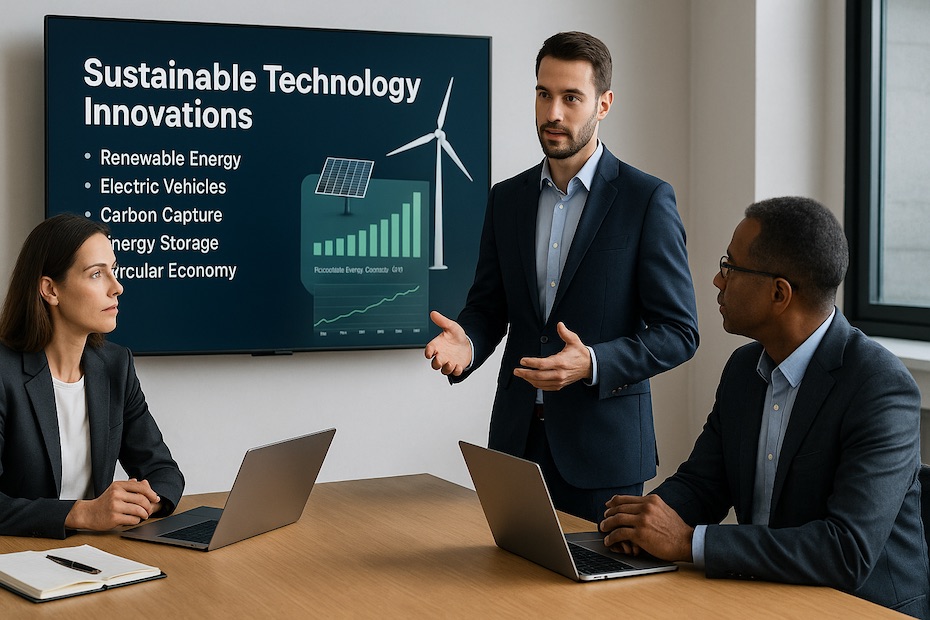
The most impactful sustainable technology innovations today combine environmental responsibility with measurable business efficiency. They’re redefining how industries operate—from energy and transport to manufacturing and materials science—by cutting emissions, extending resource cycles, and optimizing energy systems.
In this article, you’ll explore five major breakthroughs driving sustainable progress across the globe. You’ll understand how each innovation works, its commercial applications, and how you can position your organization to benefit early from their advancements.
1. Structural Battery Composites
Structural battery composites (SBCs) represent one of the most exciting frontiers in energy storage. Instead of adding heavy lithium-ion batteries into vehicles or devices, these materials store energy within their own structure. The composite itself acts as both the frame and the battery—reducing weight, saving space, and improving energy efficiency.
Researchers at Chalmers University of Technology and others have achieved materials with specific energy densities around 24 Wh/kg while retaining structural stiffness suitable for load-bearing applications. This means future electric vehicles or drones might use their own carbon-fiber chassis as batteries, eliminating the need for separate battery packs.
The benefit extends beyond transportation. Aerospace, robotics, and even consumer electronics industries are exploring SBCs to simplify design and reduce component redundancy. If you oversee R&D or product innovation, start monitoring suppliers working in this field—companies like Bcomp or research spin-offs from Volvo and Airbus are already experimenting with prototypes that could enter commercial use within the decade.
Practical implementation strategies include:
- Partnering with materials research institutions for early trials.
- Designing hybrid structures that use both SBCs and traditional cells.
- Auditing product design processes for opportunities to reduce weight through integrated energy materials.
Structural battery composites will likely evolve into one of the most commercially viable energy-storage solutions for next-generation mobility.
2. Advanced Grid Management and Smart Grids
As renewable energy sources like solar and wind grow, managing power flow becomes complex. Smart grid technologies use sensors, automation, and AI-driven analytics to balance load, reduce losses, and ensure grid reliability.
A smart grid integrates distributed energy resources—solar rooftops, EV chargers, microgrids—into one intelligent ecosystem. Through digital twins and real-time data analytics, operators can forecast demand and prevent blackouts. This is particularly valuable as cities electrify transport and transition to intermittent renewables.
Governments and utilities worldwide are investing heavily in grid modernization. The International Energy Agency (IEA) estimates global investments in smart grids will surpass $400 billion by 2030. Advanced systems like those deployed by Siemens, Schneider Electric, and ABB already use edge computing to optimize power distribution dynamically.
To leverage this innovation, consider pilot programs in microgrid technology or demand-side management within your operations. The insights gained can directly improve energy reliability and operational cost control.
Real-world applications include:
- Industrial parks implementing local energy optimization systems.
- Buildings integrating IoT-enabled smart meters and demand response tools.
- Cities deploying autonomous control for renewable balancing.
For executives managing sustainability portfolios, smart grid investments are no longer optional—they’re a strategic necessity for energy resilience and cost predictability.
3. Carbon Capture, Utilization, and Storage (CCUS)
Carbon capture technologies aim to intercept CO₂ emissions before they enter the atmosphere—or remove existing emissions directly from the air. They form a crucial part of any realistic net-zero pathway, complementing renewable energy deployment.
Industrial-scale CCUS systems, such as those from Climeworks or Carbon Engineering, extract CO₂ for storage underground or reuse in fuels, building materials, and polymers. Emerging processes even convert captured carbon into synthetic hydrocarbons or methanol, effectively “recycling” emissions into economic products.
While costs remain high, innovation is accelerating. According to the Global CCS Institute, operational CCUS capacity more than doubled between 2021 and 2024, with over 200 projects now in development globally. The combination of supportive regulation and private-sector collaboration is rapidly moving this technology toward mainstream adoption.
If your business operates in energy-intensive industries—cement, steel, or chemicals—investigate feasibility studies for point-source carbon capture. You can also explore strategic partnerships with companies that reuse CO₂ in production, reducing both emissions and raw material costs.
Early-stage steps to consider:
- Audit major emission points for CCUS compatibility.
- Monitor tax credits or incentive frameworks for capture and storage investments.
- Partner with innovators in carbon-to-value manufacturing.
CCUS isn’t just about offsetting—it’s about creating a profitable circular carbon economy.
4. Circular Economy Technologies and Remanufacturing
The linear “take-make-dispose” model is rapidly giving way to circularity—where products, materials, and components remain in circulation as long as possible. Technologies enabling this shift—AI-powered sorting, advanced material recovery, and digital product passports—are now mature enough for wide-scale deployment.
Circular Computing, for instance, remanufactures laptops using precision reengineering, achieving up to 97% quality restoration while cutting CO₂ emissions by 40%. Similarly, companies in fashion, construction, and electronics are using blockchain to trace material flows and ensure recyclability.
This innovation extends beyond waste management—it’s about redesigning products for recovery and reuse from the start. Using predictive maintenance and IoT sensors, companies can anticipate when parts will fail and reclaim them efficiently. The shift creates entirely new revenue models based on refurbishment and leasing instead of disposal.
Core strategies to start implementing include:
- Introducing take-back programs for used components.
- Using modular design principles for easier repair and recycling.
- Partnering with remanufacturers to extend product lifecycles.
Circular technologies don’t just reduce waste—they unlock profitability through resource efficiency. For companies under ESG pressure, adopting them isn’t optional; it’s a direct route to measurable sustainability and competitive differentiation.
5. Green Nanotechnology and Material Science
Green nanotechnology applies nanoscale engineering to minimize environmental impact while improving performance across multiple industries. From water purification to energy efficiency, this field is rapidly expanding in both research and practical deployment.
Nano-engineered coatings, for example, enhance the performance of solar panels by improving light absorption. In manufacturing, nano-catalysts speed up chemical reactions with less energy consumption. Meanwhile, nanofiltration membranes allow advanced wastewater treatment by selectively removing contaminants without excessive energy use.
The global green nanotechnology market is projected to exceed $60 billion by 2030, driven by demand for sustainable construction, electronics, and energy storage materials. This growth is supported by innovation hubs at institutions like MIT and the University of Cambridge, where researchers are developing eco-friendly nanocomposites for automotive and aerospace use.
If you manage product innovation, explore partnerships with nanomaterial startups or university labs. Small-scale pilots can demonstrate efficiency gains quickly and justify further investment.
Practical steps to begin adoption include:
- Testing nano-enhanced coatings for corrosion resistance or solar efficiency.
- Evaluating nanomaterial suppliers for sustainability certification.
- Applying nanofiltration to reduce industrial water waste.
Green nanotechnology represents the quiet revolution underpinning material innovation—subtle yet powerful enough to redefine sustainability in manufacturing and energy.
Quick Summary of Top Sustainable Tech Innovations
- Structural battery composites
- Advanced smart grid systems
- Carbon capture and utilization
- Circular economy technologies
- Green nanotechnology
Lead the Transition to Smarter Sustainability
Technology is no longer a passive enabler—it’s the driver of global sustainability. By adopting these innovations early, you can future-proof operations, enhance efficiency, and strengthen your market position. The key is to combine practicality with vision: pilot, measure, refine, and scale. Your proactive adoption today defines tomorrow’s sustainable enterprise.

