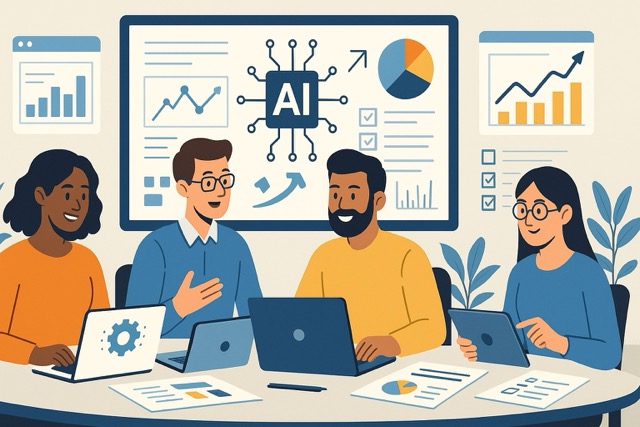

Artificial intelligence (AI) has transformed the way small businesses conduct market research. Gone are the days when gathering customer insights required extensive surveys, manual data collection, and time-consuming analysis. AI-driven tools now allow businesses to collect, process, and analyze vast amounts of data in real time, providing deeper insights into customer behavior, industry trends, and competitive landscapes. This shift enables small businesses to compete with larger corporations by making data-driven decisions faster and more efficiently. In this article, I’ll explore how AI is revolutionizing market research and how small businesses can leverage it to their advantage.
Automating Data Collection and Analysis
Small businesses no longer need to rely on traditional market research methods like focus groups or expensive research agencies. AI-powered tools such as sentiment analysis software, chatbots, and data mining applications automate data collection from social media, customer reviews, and online forums. This automation provides real-time insights, eliminating the need for businesses to wait weeks or months for reports.
With AI’s ability to analyze massive datasets within minutes, businesses can identify patterns and trends that would otherwise go unnoticed. By leveraging machine learning algorithms, AI can sift through unstructured data—such as customer sentiments on social media—and categorize it into actionable insights. This allows small businesses to understand customer preferences, expectations, and concerns without the need for manual data crunching.
Enhancing Customer Understanding
AI-driven market research tools excel at segmenting customers based on their behavior, demographics, and preferences. Businesses can utilize AI to group audiences into different segments and tailor their marketing efforts accordingly. Customer relationship management (CRM) systems, powered by AI, enable businesses to track customer interactions and provide personalized recommendations based on past purchases and browsing history.
This level of customer understanding helps businesses improve engagement, develop more effective marketing campaigns, and boost retention rates. AI can even predict customer needs, allowing businesses to proactively address concerns before they arise. Personalized interactions foster stronger relationships, increasing the likelihood of customer loyalty and repeat business.
Predictive Analytics for Strategic Planning
AI’s predictive capabilities allow small businesses to forecast trends and anticipate customer demands. Predictive analytics tools analyze historical data to identify patterns that indicate future behaviors. For instance, AI can predict which products will be in demand during specific seasons or which marketing strategies will yield the highest return on investment.
This predictive power helps businesses optimize inventory, allocate resources efficiently, and make informed decisions about pricing and promotions. Instead of relying on intuition, small businesses can use AI-driven insights to strategize effectively, reducing the risk of costly mistakes and ensuring they stay ahead of market shifts.
Improving Decision-Making
One of the biggest challenges for small business owners is making informed decisions quickly. AI-powered market research tools remove guesswork by providing data-backed insights. AI algorithms can analyze customer feedback, sales trends, and competitor activities to offer clear recommendations on what actions to take.
For example, AI-powered competitive analysis tools monitor competitors’ pricing, customer sentiment, and promotional strategies. By comparing this data with internal business metrics, entrepreneurs can adjust their own strategies to maintain a competitive edge. AI also helps identify potential opportunities, allowing businesses to pivot before market trends change.
Cost-Effective Market Research
Traditional market research methods can be prohibitively expensive for small businesses. Hiring research firms, conducting surveys, and purchasing industry reports often come with high costs. AI democratizes market research by providing cost-effective solutions that automate data collection and analysis.
AI tools, such as Google Analytics, IBM Watson, and Nielsen’s AI-powered research platforms, enable businesses to gather critical insights without investing in expensive external research. This affordability allows small businesses to compete with larger companies, leveling the playing field and ensuring they have access to the same high-quality market intelligence.
Real-Time Competitive Analysis
Understanding the competition is essential for any business, and AI streamlines this process by monitoring competitors in real time. AI-powered tools track competitor activities, including pricing adjustments, marketing campaigns, and customer reviews. This continuous monitoring provides businesses with instant insights into what strategies their competitors are using and how they are performing in the market.
By leveraging this data, businesses can respond proactively to market changes, refine their own strategies, and identify gaps in the market. Real-time competitive analysis allows small businesses to react swiftly, ensuring they stay ahead rather than lagging behind industry trends.
Enhancing Customer Engagement
AI doesn’t just provide insights; it also enhances the way businesses interact with customers. Chatbots, AI-powered email marketing platforms, and personalized content recommendation engines help businesses engage customers more effectively. These tools analyze customer behavior and tailor interactions accordingly, ensuring that marketing efforts feel relevant and timely.
For instance, AI-driven email marketing platforms can segment customers based on past behaviors and send personalized messages that resonate with each recipient. AI-powered chatbots can provide instant customer support, answering common queries and guiding potential buyers through the purchasing process without human intervention.
Streamlining Operations
Beyond research and engagement, AI improves operational efficiency. By automating time-consuming tasks, businesses can focus on high-value activities that drive growth. AI-powered automation tools handle data entry, market research report generation, and trend analysis, reducing the need for manual intervention.
With AI streamlining operations, businesses save time and resources while improving accuracy. The ability to automate repetitive tasks ensures that small business owners can allocate their energy to strategic initiatives rather than getting bogged down in data collection and analysis.
How AI Benefits Small Business Market Research
- Automates data collection and analysis
- Enhances customer segmentation and personalization
- Provides predictive analytics for future trends
- Supports data-driven decision-making
- Offers cost-effective research solutions
- Tracks competitor activities in real time
- Improves customer engagement through AI-driven interactions
In Conclusion
AI has fundamentally changed market research for small businesses by making data analysis faster, more affordable, and more insightful. Entrepreneurs no longer have to rely on outdated methods to understand customer behavior or market trends. Instead, AI-powered tools provide real-time, predictive insights that drive smarter decision-making. By integrating AI into their market research processes, small businesses can operate more efficiently, tailor their marketing strategies, and stay ahead of the competition, ultimately positioning themselves for long-term success.
“AI is revolutionizing market research for small businesses, offering real-time insights, predictive analytics, and cost-effective solutions. Learn how to leverage AI for smarter decision-making: X (Twitter).”